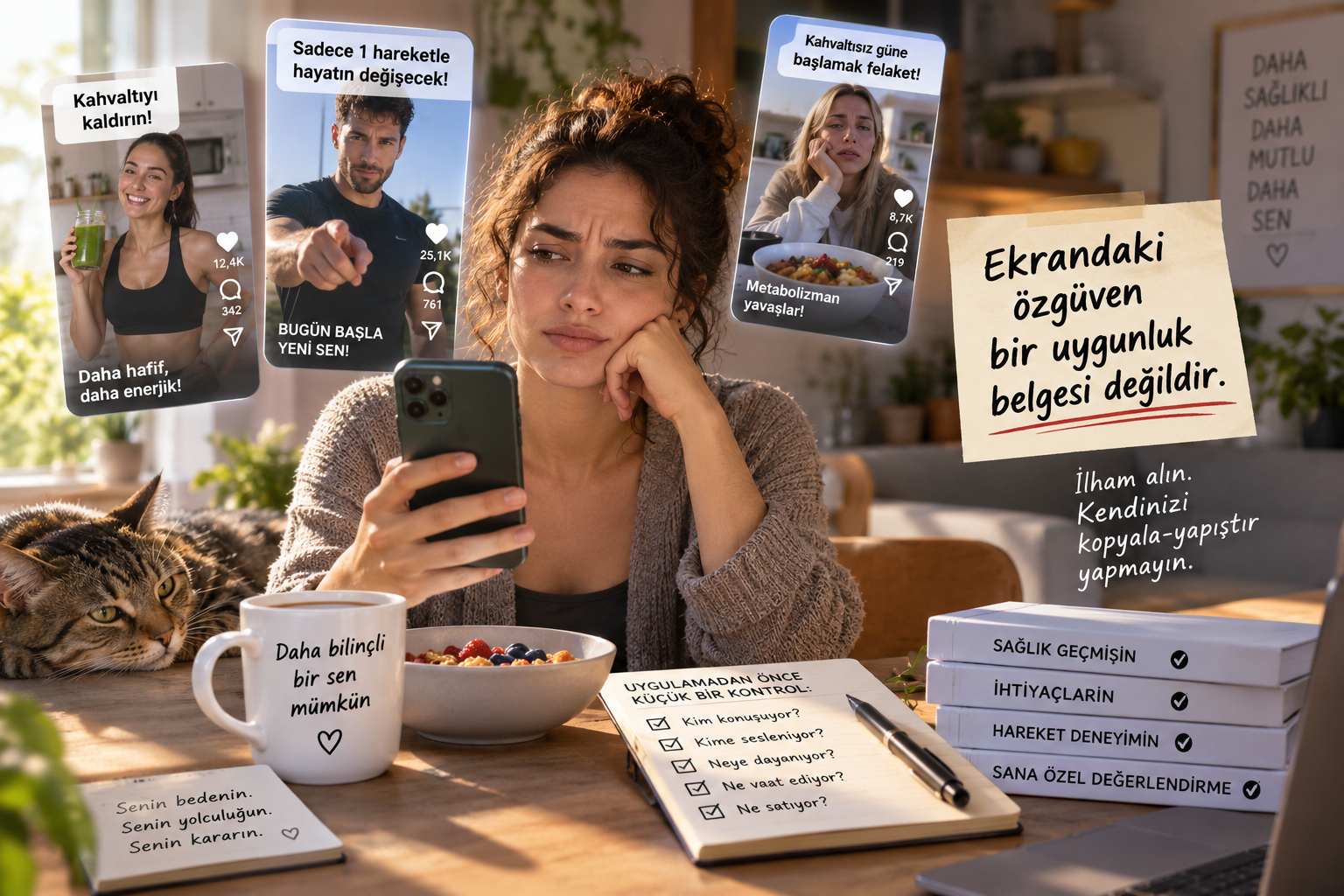
Confidence on camera doesn't mean a good fit for you
You open your phone in the morning. One person has canceled breakfast; another says skipping it is a disaster. A third promises that one exercise will change your entire life. Your tea hasn't even brewed, and you already have three competing life plans. Congratulations: the algorithm clocked in early again.
Here is my suggestion: Don't mistake someone's confidence for evidence that their advice suits you. Good lighting, an impressive physique, and a convincing delivery cannot assess your health history, needs, or exercise experience.
Social media can offer ideas. But exercise and nutrition content presented without an individual assessment is not a personal prescription. That includes this article.
The same exercise doesn't lead everyone to the same place
A movement that looks easy in a video might be too demanding for you. Someone who has trained for years and someone just starting out do not have the same capacity. Previous injuries, existing health conditions, movement skills, and opportunities for recovery also differ.
So when someone says, “I do this every day, and you should too,” an important detail is missing: Who you are.
Unsuitable workloads, poor execution, or demanding exercise without enough recovery can lead to pain, excessive fatigue, and injury. For people with certain health conditions, the consequences can be more serious. A short video does not make the advice low-risk.
“If it hurts, it's working” is not a reliable guide
Making an effort during exercise is not the same as pushing through pain. Don't drown out sharp or increasing pain, dizziness, or unusual shortness of breath with motivational slogans. Stop the activity and seek appropriate medical help. Chest pain, fainting, or severe breathing difficulty may require emergency assessment.
“Don't give up” can be a great slogan. Not when it means ignoring your body's warning signals.
Someone else's plate is not your nutrition plan
“What I eat in a day” videos leave plenty off-screen: the person's needs, health conditions, allergies, medications, and whatever they eat outside the footage.
You are seeing a selected slice of their life. And looking a certain way does not prove that someone's food choices are balanced or safe for everyone.
Cutting out food groups without a sound reason, copying highly restrictive diets, or taking supplements indiscriminately can increase the risk of inadequate nutrition, fatigue, and other health problems. Some supplements can interact with medications. For people with existing medical conditions, poorly considered changes may have more serious consequences.
There is also your relationship with food to consider. Content that labels every bite “clean” or a “cheat” can reinforce guilt and rigid eating behaviors in some people. The dinner table is crowded enough without inviting an imaginary panel of social media judges.
Give advice a quick credibility check before trying it
Not every post is wrong. But identifying useful information takes more than checking a follower count. These are the questions I would ask:
- Who is speaking? Can you verify their education and professional qualifications? Is the topic actually within their expertise?
- Who is the advice for? Does it account for beginners, health conditions, or different needs?
- What supports it? Is there an explanation you can examine, or is the creator treating their appearance and experience as proof?
- What does it promise? Watch for “works for everyone,” “guaranteed results,” and “the only right way.”
- What is being sold? Is a product, supplement, or program attached to the recommendation? Are commercial relationships clearly disclosed?
An advertisement is not automatically false. But a sales motive is relevant context when evaluating advice. Likewise, a qualification does not make every claim unquestionable: trustworthy explanations acknowledge their limits and uncertainty.
Take inspiration, not a copy-and-paste identity
When a post catches your interest, pause before acting. What is the recommendation supposed to achieve? Does it explain the risks and who should avoid it? Is it asking you to make a major change?
If you have a medical condition, an injury, take regular medication, or experience difficulties around eating, don't expect a comments section to provide personal answers. Consult a physician about your health, a qualified dietitian about your nutrition needs, and an appropriately qualified exercise professional about exercise practice. When needed, they can work together.
If following advice leaves you in pain, persistently exhausted, or intensely anxious about food, don't dismiss that as a lack of discipline.
Support is not the same as pressure
Encouragement from other people can be welcome when you are active. But support should not mean forcing you to match someone else's pace or body. “I'm here for you” and “They can do it, so why can't you?” are not the same message.
If you would like encouragement during a run or walk that suits you, you can try EchoPulseFit. Start your activity in the mobile app and share a link so friends can follow your live map on the web. Viewers can send applause and similar audio/visual encouragement, and you can review your activity history. That support does not replace a health assessment.
My closing thought: take ideas from the people you follow, but don't hand them complete control over your decisions. Your body isn't a comments section. The loudest voice doesn't need to be in charge.